

What Revenue Intelligence Actually Means for CPG Suppliers Protecting Margin at Amazon, Target and Walmart
A framework to help finance and supply chain leaders distinguish genuine revenue intelligence from deduction dashboards using the term, and why the difference appears directly on the P&L
Quick definition: Revenue intelligence is the continuous analysis of a supplier's full purchase order and transaction history across every retailer, used to identify why deductions occur, where the same pattern is repeating, and what it will cost the business if nothing changes — as distinct from deduction management, which tracks and disputes individual claims after they have already occurred.
BENTONVILLE, Ark., July 16, 2026 (GLOBE NEWSWIRE) -- “Revenue intelligence” has become one of the most repeated phrases among vendors serving the consumer packaged goods deduction and recovery space, but the term means very different things depending on who is using it. STAT Recovery Services (“STAT”), the AI-powered revenue intelligence platform that has recovered more than $1 billion for retail suppliers, is publishing a clear standard for what the term should mean, and a way for finance and supply chain leaders to test whether a partner is actually delivering it.
Recovery Tells You What You Lost. Intelligence Tells You Why.
For most of the last decade, suppliers have managed deductions reactively: a claim hits the invoice, someone on the finance or AR team notices the net check came in light, and, if time and appetite allow, a dispute gets filed. In that model, recovery is a cleanup function that answers one question after the fact — what did we lose, and can we get some of it back? Revenue intelligence operates from a different question: not just what was lost, but why it was lost, where the same pattern is emerging across retail accounts, and what it will cost next quarter if nothing changes.
The Three Questions Real Revenue Intelligence Must Answer
Without the marketing language, any legitimate revenue intelligence capability should be able to answer three questions for a supplier:
• What's actually being taken? Not the summary number on the remittance, but the transaction-level detail behind every deduction, chargeback, and allowance across each retailer.
• Why does it keep happening? The root cause, a recurring shortage claim, a pricing mismatch loaded in the item file, an OTIF pattern tied to a specific distribution center. These have sources, and the source is where the money is.
• What happens if nothing changes? The forward view: if the same leakage repeats at the same rate, what does that do to margin over the next two, four, or six quarters?
Recovery answers the first question. Intelligence answers all three.
Why This Belongs on the P&L, Not Just the Deduction Ledger
For a CFO or VP of Finance, deductions are rarely evaluated one at a time; they are evaluated as a line item against gross margin. A single unresolved chargeback is immaterial. The same claim pattern repeating undetected across every purchase order at a retailer for two or three quarters is a forecasting and margin problem, not a dispute-queue problem, and it belongs in a board deck rather than a spreadsheet. Revenue intelligence gives finance leaders the forward view a reactive dispute process cannot: which retailer relationships are compressing gross margin fastest, what a specific root cause is costing on an annualized basis, and how much of that erosion remains preventable versus already lost.
Because STAT operates on a performance based fee structure tied to incremental recovery, with no upfront cost and no ERP integration required, finance leaders can quantify this exposure and build it into forecasting and trade spend planning without allocating budget or headcount to find out.
Why Deduction Data Alone Isn't Intelligence
Plenty of tools will show a tidy dashboard of deductions and call it insight, but a deduction viewed in isolation is just an event: it tells you money left, not why. Real intelligence comes from connecting the deduction back to the operational reality that produced it: purchase orders, inventory movement, supply chain performance, procurement activity, and compliance trends. This is also where a single-retailer view breaks down. A supplier selling into Amazon, Target, and Walmart is losing revenue in three different ways: Walmart's PO-based claim logic, Amazon's algorithmic inventory reprocessing, and Target's own model. Intelligence means one coherent, cross-retailer picture instead of three disconnected spreadsheets.
What It Looks Like From the Supplier's Seat
For the finance leader, revenue intelligence should collapse a familiar gap: the distance between the net payment the team sees and the gross value that was actually earned, with the reason for each piece of that gap made visible and traceable back to a root cause and a retailer. For supply chain and sales teams, it means catching a leak while it is still small: a claim pattern flagged this month is a prevention conversation, while the same pattern discovered eighteen months later is a write-off. For the business as a whole, it shifts recovery from a periodic recapture effort to continuous margin protection, where the goal is not only to recover what was lost, but to prevent more losses in the first place.
The Test: Intelligence or Just Invoices?
If “revenue intelligence” is going to mean anything, a supplier or its finance team should be able to hold a partner to it. Four questions worth asking:
• Can you show me the root cause of my top three recurring deductions, not just the amounts?
• Do you see my Amazon, Target, and Walmart activity in one view, or in silos?
• Are you helping me prevent next quarter's claims, or only disputing last quarter's?
• Is your analysis built on my full operational data, or only the deductions that have already been filed?
A recovery vendor can typically answer the first half of each question. A revenue intelligence partner should be able to answer the second half of all four.
Where This Is Headed
The suppliers that best protect margin over the next few years will not be the ones that dispute the fastest. They will be the ones who stop treating lost revenue as something to reconcile after the fact, and start treating it as something to see, understand, and prevent, continuously and across every retailer they serve. That is the standard STAT has built its platform to meet, and the standard finance and supply chain leaders should hold any partner claiming the term to.
“Finance leaders don't need another dashboard that tells them what already happened. They need a forward view of where margin is deteriorating and why, early enough to intervene before it shows up in next quarter's numbers. That's the difference between recovery and intelligence, and it's the difference we build our platform around,” said John Gunther, SVP Sales & Marketing, at STAT.
Suppliers can see what this looks like against their own data through STAT's complimentary two-year historic audit, which reviews 24 months of Amazon, Target, and Walmart transactions with no upfront fees and no ERP integration required.
About STAT Recovery Services
Headquartered in Bentonville, Arkansas, STAT Recovery Services is an AI-powered revenue intelligence platform that helps retail suppliers recover hidden revenue leakage, manage deductions, and prevent future losses across every major retailer, including Walmart, Target, and Amazon. Combining a proprietary AI/ML engine with a team of CFA- and CPA-led auditors, STAT has recovered more than $1 billion for clients ranging from emerging brands to Fortune 500 companies, with no upfront cost and no cost unless funds are recovered. Learn more at statrecovery.com.
Media Contact:
Claire Reed | claire@statrecovery.com | statrecovery.com
A photo accompanying this announcement is available at https://www.globenewswire.com/NewsRoom/AttachmentNg/b5e5d4d7-c960-475c-a4fc-05e6a9f0bdd6


STAT Revenue Intelligence
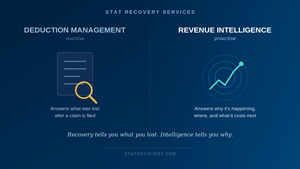
STAT Recovery defines what 'revenue intelligence' really means for CPG suppliers — and why the difference shows up on the P&L.
Legal Disclaimer:
EIN Presswire provides this news content "as is" without warranty of any kind. We do not accept any responsibility or liability for the accuracy, content, images, videos, licenses, completeness, legality, or reliability of the information contained in this article. If you have any complaints or copyright issues related to this article, kindly contact the author above.
